
SLA parts were perfectly flat in their green state. A custom high-precision enclosure, a critical card case slot, pin holes that must align perfectly, and a post-cure cycle that pulls the whole print out of true.
The job we walked into involved SLA parts that looked pristine off the build plate. Once they went into the UV and thermal post-cure, internal stresses took over. Flat surfaces bowed, aligned holes drifted, and the critical slot warped just enough to bind the assembly.
The Post-Cure Distortion Problem
Post-cure thermal stress rules out forcing warped parts flat or filing holes by hand. When resin cures, the polymerisation reaction and the heat of the UV chamber create uneven internal stresses. In a precision assembly, even a small warp means misaligned pin holes and slots, leading to binding, accelerated wear, or complete assembly failure on the factory floor.
A warped slot means a jammed card case, and a jammed case means a failed assembly. We don't try to solve this by wrestling the material back into shape after the fact. The work that decides a project's success is the design. We would rather solve a problem on paper or through R&D than on the shop floor. By front-loading risk into the design phase, we anticipate failure modes and shrink them before cutting metal or printing resin.
Designing Out the Warp
We addressed the warp through two design interventions.
First, we modified the part geometry. We added geometric bracing and redistributed mass along the bending centroid. This balanced the material volume, preventing the uneven heat absorption that causes rapid heating and cooling to distort the part.
Second, we controlled the thermal environment during the cure itself. We built custom curing fixtures using Bosch Rexroth structural framing. These fixtures supported the green parts during the post-cure cycle, allowing them to be gently heated and cooled, which minimised the thermal shock that triggers warping.
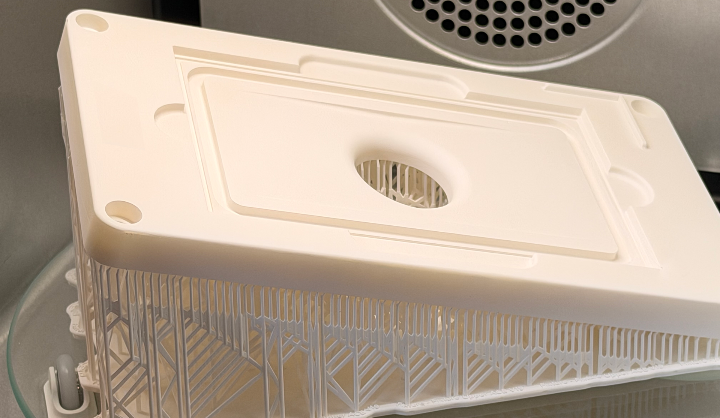
The Hybrid SLA-to-CNC Workflow
Even with managed heating and bracing, some residual stress is inevitable in large SLA prints. To hit the final tolerances, we designed a hybrid SLA-to-CNC workflow.
Instead of trying to print the final holes to size, we printed them undersized or solid. We added a specific physical feature to the part design near the card case slot to act as a temporary datum. After the part was fully cured and the warp had stabilised, we mounted it on a CNC mill.
By datuming off this physical feature on the machine, we could CNC-machine the critical surfaces and drill the pin holes in perfect, repeatable alignment with the slot. It sounds counter-intuitive to machine a 3D printed part, but it was the only way to guarantee the alignment. We show the decision and the reasoning, never the proprietary mechanism. In this case, the solution lay in how we sequenced the manufacturing steps, allowing the plastic to warp first before machining the precision features.